
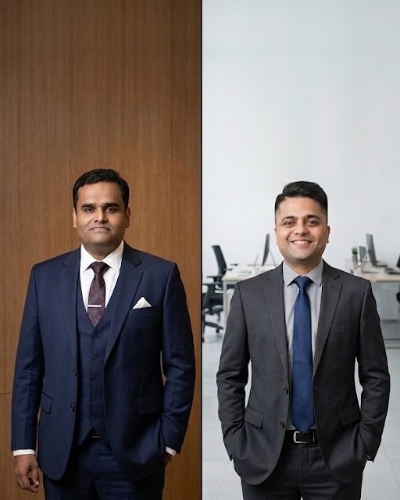
India, Sept. 24 -- From Pune to an enterprise software business spanning India and the United States, Borawake has built AvanSaber alongside Nikhil Jathar around a practical concern: how to give businesses the benefits of AI while retaining control over their operations.
An AI system that prepares an invoice enters a different world from one that drafts an email. The figures must be correct, the person requesting it must have the authority, and the business must be able to establish what happened afterwards. For Varun Borawake, Co-Founder and Chief Executive Officer of AvanSaber, those requirements sit at the heart of the company's approach to enterprise software.
His interest in technology began with the people expected to use it. In written responses prepared for a recent interview, Borawake described a recurring frustration among businesses: the distance between what their software promised and what it allowed them to do in practice. Understanding that distance became the foundation of his work in product strategy, partnerships and bringing software to market.
"I came into technology through customers rather than through code," he wrote.
Borawake and fellow co-founder Nikhil Jathar started AvanSaber in Pune in 2014 and incorporated in the United States in 2016. After serving as Chief Operating Officer and Managing Director, Borawake became CEO in January 2024. He oversees strategy, sales, marketing and partnerships across the company's Indian and American operations.
Borawake and Jathar's earlier successes include the sale of a stake in ZapInventory to InvenSync and the Super Snail app name to Hong Kong-based QCPlay.
The partnership gives each founder a distinct responsibility. Borawake must understand which problems customers will commit time and money to solving. Jathar, the company's Chief Technology Officer and principal architect, must translate those needs into systems whose behaviour can be examined and tested. The commercial promise and the engineering decision have to withstand the same scrutiny.
That relationship is particularly relevant to AI adoption. A business may be comfortable using an assistant to summarise a document long before it is ready to let the same assistant change financial records. For Borawake, the work of adoption includes deciding where to begin, explaining the limits and allowing users to build confidence through experience.
ERPClaw, AvanSaber's open-source, AI-native enterprise resource planning platform, puts this thinking into a product. It brings natural-language interaction to functions such as accounting, inventory and business operations. Underneath that interface, the company's design separates what an AI agent proposes from what the software permits it to execute.
Borawake credits Jathar with designing the governance engine at the centre of that approach. Proposed actions are checked against defined business rules before they are allowed to change records. An instruction does not acquire authority simply because an AI system has interpreted it confidently. Accounting requirements and access permissions remain matters for the software to enforce.
The significance of Jathar's contribution lies in that connection between AI capability and the discipline of enterprise systems. It brings a familiar operational concern, knowing who can do what and under which conditions, into software that accepts requests in ordinary language. For a buyer considering AI in a consequential workflow, that is a practical design choice with commercial importance.
His work also extends into research and invention. Jathar is the sole inventor named on US patent applications relating to the architecture and the sole author of a paper on the underlying design accepted at IEEE IRI 2026. These are specific outputs through which the technical work can be examined beyond a product demonstration.
AvanSaber's testing work offers another example. TailTest addresses the need to test software produced with AI agents. According to the company's account of one production run, it identified 25 defects across six open-source Python projects; the run also produced 35 upstream defect reports, with eight fixes subsequently made by maintainers. The distinction matters: finding a possible problem internally and seeing an external maintainer act on a report are different stages of the work.
For Borawake, such engineering work informs how the company presents its products. Customers need an explanation of the task a system can perform, the checks applied to it and the evidence available when something goes wrong. Those questions shape the scope of an implementation as much as the feature list does.
His preferred approach is to begin with a narrow task whose result can be checked, let users observe it and expand responsibility as confidence develops. It places a clear obligation on the company selling the system: make the limits understandable before asking a customer to depend on it.
Keeping ERPClaw open source is part of that approach. Businesses can inspect the code and evaluate the controls for themselves. For AvanSaber, it also means the reasoning behind a technical claim can become part of the buying conversation.
Borawake's ambition is to build a company that enterprises turn to when they are ready to introduce AI into operations that matter. His partnership with Jathar gives that ambition two connected responsibilities: understanding the business well enough to make a useful promise, and engineering the software carefully enough to keep it.
Disclaimer: This is a Press Release distributed by HT Syndication. For queries write to contentservices@htdigital.in